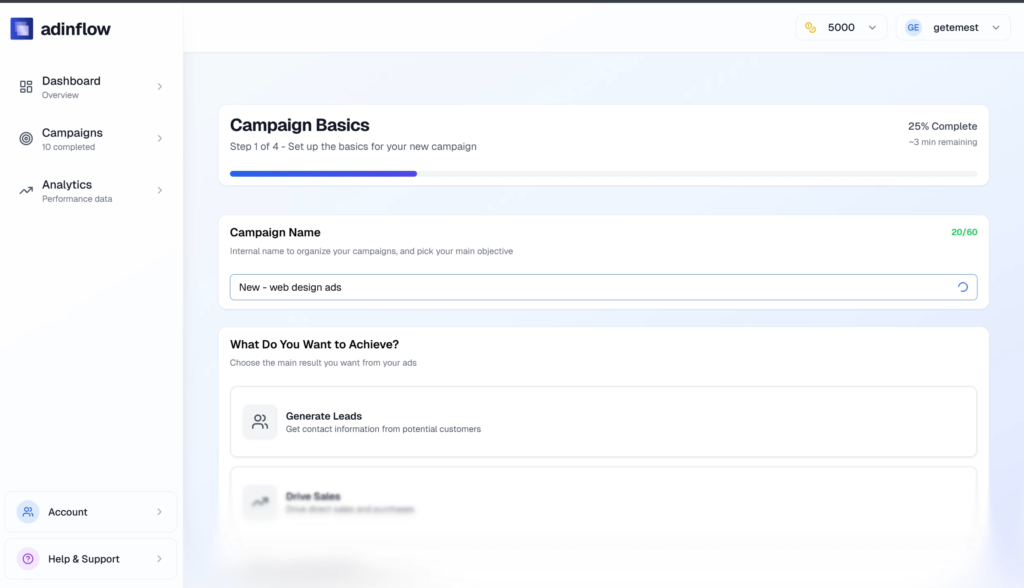
We improved how AdInflow evaluates markets, expands locations, and handles campaign decision logic – especially for small and local businesses.
The result:
- smarter market sizing
- safer geo expansion
- fewer false rejections
- more predictable campaign generation
Launching Google Ads sounds simple – until you try to do it well for a small city, a niche service, or a local business with limited search volume.
That’s where many automated systems start making weak decisions.
A market can look too small on paper, even when the intent is strong.
A location can look valid as a plain string, even when the targeting logic behind it is fragile.
And a campaign flow can technically stop without being a true success.
Over the last updates, we improved how AdInflow handles these cases.
The goal was simple: make campaign generation more accurate, more reliable, and less likely to reject viable campaigns for the wrong reasons.
Why this update matters
Here’s the short version:
| Area | Before | Now |
|---|---|---|
| Market sizing | Could rely too much on rough heuristics | Uses stronger real market signals |
| Geo expansion | Risk of fuzzy or unreliable location logic | More deterministic and structured |
| Small markets | Could be judged by broad-market standards | Better adapted to local and niche cases |
| Viability checks | One-size-fits-all thresholds | More adaptive thresholds |
| Pipeline outcomes | Some stop states could look too similar | More predictable completion logic |
What changed in practice?
AdInflow is now better at handling campaigns for local businesses, smaller countries, niche services, and location-sensitive setups.
The core problem: small markets break simplistic logic
A lot of ad automation looks good until it meets a smaller market.
That’s where simplistic logic starts showing cracks.
If you apply the same rules to a local service in a smaller city that you would apply to a broader US or UK market, you can easily reject campaigns that are actually viable.
And that usually happens for one of three reasons:
- the system over-relies on population
- the system treats locations too loosely
- the system uses universal thresholds where adaptive logic is needed
Small market does not automatically mean weak opportunity.
In Google Ads, what matters is not just size.
It’s intent, demand, structure, and whether the search behavior supports a workable campaign.
Quick takeaway
A small market can still be a strong market.
Especially when the service is specific, local, and intent-driven.
Why market size is more than population
One of the biggest lessons behind this update was simple:
Population is a weak proxy for market opportunity.
A city can have a decent population and still show weak search demand for a service.
And the opposite can also happen: a smaller location can still support a solid campaign if the intent is there.
So instead of leaning too heavily on rough location heuristics, we improved AdInflow’s market sizing logic to use stronger real-world signals.
That means decisions are now based more on actual keyword and market data – not just surface-level assumptions.
Before vs after
| Question | Old logic tendency | Better logic |
|---|---|---|
| “Is this market large enough?” | Look at rough size signals | Check actual search demand too |
| “Should this campaign move forward?” | Generic thresholds | Market-aware thresholds |
| “Does this location support this service?” | Broad assumptions | Evidence from real signals |
This is a much closer match to how real advertisers think.
Because in practice, nobody serious evaluates Google Ads opportunity by population alone.
Why geo expansion needs deterministic logic
This was the second big improvement.
Geo expansion sounds simple in theory.
In practice, it’s easy to make it messy.
If you treat locations as plain text, or allow fuzzy expansion too early, you create room for:
- poor matches
- inconsistent targeting
- cross-market noise
- plausible-looking but wrong expansion logic
That’s why we moved toward deterministic geo hierarchy, using real Google Ads location structure instead of relying on loose interpretation.
What that means
Instead of saying:
“This location string looks close enough”
the system now works more like:
“This is a real resolved location, with a real parent chain, inside a real targeting structure”
That makes geo expansion:
- cleaner
- safer
- more consistent
- much more reliable for campaign logic
A simple way to think about it
| Approach | Risk |
|---|---|
| Plain strings | Ambiguous interpretation |
| Fuzzy AI-only expansion | Plausible but unreliable matches |
| Structured resolved geo hierarchy | Clearer and safer targeting logic |
Good targeting logic should not depend on guessy geography.
What we changed in AdInflow
Here’s the product-level summary of the update:
Market evaluation
- improved market-size detection using stronger market signals
- reduced reliance on rough population-style heuristics
- added better support for small and local market evaluation
Geo logic
- improved geo expansion using real location hierarchy
- removed weaker forms of location interpretation
- made location handling more structured and consistent
Viability logic
- replaced universal threshold logic with more adaptive thresholds
- reduced false rejections in small-market and niche cases
- better aligned viability checks with actual market context
Reliability and orchestration
- improved completion logic
- made controlled stop states more predictable
- improved error handling and generation consistency
What this changes for users
This update is especially relevant if you work with:
- local businesses
- niche services
- smaller regions or countries
- campaigns with tighter geographic intent
- markets that don’t fit broad default assumptions
In practical terms, this means:
✅ fewer false “this market is too small” outcomes
✅ better handling of local and niche campaigns
✅ more reliable location expansion
✅ cleaner generation decisions
✅ more predictable campaign flow behavior
That’s the kind of reliability that actually matters.
Not just “the system didn’t crash.”
But “the system made a better decision.”
Reliability is not just about errors
This part matters a lot.
When people hear reliability, they often think about:
- uptime
- failed requests
- retries
- crashes
But for an AI product, reliability is also about decision quality.
A system can run without errors and still be unreliable if it:
- rejects valid campaigns
- expands targeting badly
- confuses stop states with successful outcomes
- makes brittle assumptions in edge cases
That’s why this update matters beyond engineering cleanup.
It improves the quality of the decisions AdInflow makes before a campaign is generated.
And that’s where trust is built.
Snapshot: what got better
Before
A smaller market could be judged too harshly.
A location could look valid but still carry weak targeting logic.
Some outcomes could be technically clean but logically misleading.Now
Market evaluation is smarter.
Geo expansion is more grounded.
Campaign outcomes are more predictable.
And viable local campaigns are less likely to be filtered out for the wrong reasons.
Why this matters for AI-powered Google Ads tools
A lot of AI tools focus on speed first.
That part is easy to market.
What’s harder – and much more important – is making sure the system stays reliable when:
- inputs are messy
- markets are uneven
- geographies are nuanced
- edge cases show up
That’s the real challenge.
Because useful automation is not just about generating something fast.
It’s about generating something that still makes sense under real-world constraints.
Our direction going forward
This update reflects a broader direction inside AdInflow:
- less guesswork
- better structured logic
- stronger market evaluation
- more grounded automation
- better handling of real-world campaign variance
We still believe in AI-driven speed.
But speed alone isn’t enough.
The goal is to make campaign generation:
- fast
- usable
- trustworthy
- and much more consistent across different market types
Or put simply:
Not more AI for the sake of it. Better decision systems around it.
Final takeaway
If you’re building campaigns for local businesses, niche services, or smaller markets, simplistic automation tends to break faster than people expect.
This update is part of making sure AdInflow doesn’t.
We made market sizing smarter.
We made geo expansion safer.
We made viability checks more adaptive.
And we made campaign generation more reliable where it matters most.
Try AdInflow
If you want to build Google Ads campaigns with smarter market evaluation, stronger location logic, and a more reliable path from setup to launch, try AdInflow.