Small businesses no longer need to rely on expensive agencies or guesswork to run profitable advertising. With the right setup and modern AI tools, google ads for small business can be predictable, scalable, and manageable—even with limited time or budget.
In this guide, you’ll learn how small businesses actually succeed with Google Ads in 2026, what usually goes wrong, and how ai google ads platforms remove the complexity without sacrificing performance.
Why Google Ads Still Works for Small Businesses (If Done Right)
Google Ads remains one of the few channels where intent comes first. You’re not interrupting users—you’re showing up exactly when someone searches for what you sell.
For small businesses, that means:
-
Faster time to first lead or sale
-
Full control over budget and targeting
-
Measurable ROI from day one
The problem isn’t Google Ads itself. The problem is how campaigns are usually built.
Where Small Businesses Lose Money in Google Ads
Most underperforming accounts share the same issues:
1. No Real Campaign Strategy
Many campaigns start with “pick a few keywords and write some ads.” That’s not a strategy. Without market analysis, ICP definition, and intent mapping, spend gets wasted fast.
2. Overloaded Keywords
Broad keywords without structure cause ads to show for irrelevant searches. This inflates CPCs and kills conversion rates.
3. Weak Ad Copy
Generic headlines don’t match search intent. If your ads look like everyone else’s, Google has no reason to reward them.
4. Manual Setup Fatigue
Small business owners don’t have time to build:
-
Dozens of ad groups
-
Multiple ad variations
-
Extensions and assets
-
Budget distribution logic
This is where AI becomes a competitive advantage.
How AI Changed Google Ads for Small Businesses
Modern ai google ads tools don’t just “write ads.” They automate decision-making that used to require years of experience.
The best platforms now handle:
-
Keyword clustering based on intent
-
Campaign and ad group structure
-
Conversion-focused ad copy
-
Budget allocation across campaigns
-
Policy compliance checks
Instead of guessing, small businesses start with a data-backed setup.
What an AI-Powered Google Ads Workflow Looks Like
Here’s how small businesses can launch faster and smarter today:
Step 1: Define the Business, Not Just the Product
AI systems analyze:
-
Your market category
-
Customer pain points
-
Buying intent stages
This replaces hours of manual research.
Step 2: Automatic Keyword & Structure Generation
Instead of dumping hundreds of keywords into one campaign, AI builds:
-
Themed campaigns
-
Clean ad groups
-
Search intent alignment
This structure directly impacts Quality Score.
Step 3: High-Intent Ad Copy at Scale
AI-generated ads focus on:
-
Search intent matching
-
Clear value propositions
-
Conversion-oriented CTAs
Not just “creative writing,” but ads designed to win auctions.
Step 4: Smart Budget Distribution
Rather than splitting budgets evenly, AI allocates spend based on:
-
Keyword intent value
-
Funnel stage
-
Conversion likelihood
This is critical for small budgets.
Running Google Ads Without an Agency: Is It Realistic?
Yes—if you use the right tools.
Traditional agencies:
-
Are expensive for small budgets
-
Often reuse templates
-
Require long onboarding cycles
AI platforms remove that friction.
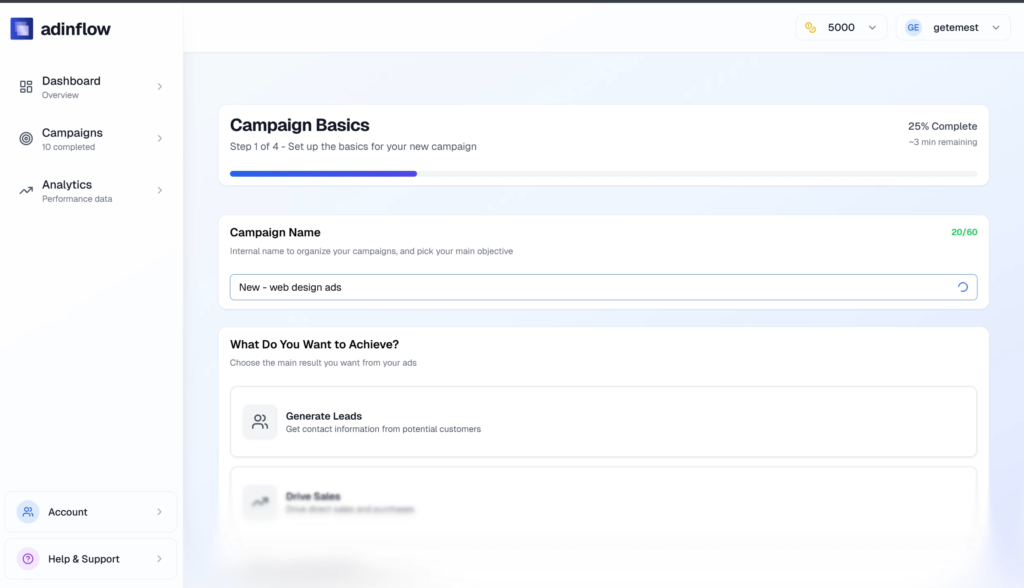
With Adinflow, small businesses can:
-
Generate a full Google Ads strategy automatically
-
Build campaigns, ad groups, and ads in minutes
-
Stay compliant with Google Ads policies
-
Export directly to a Google Ads account or CSV
All from one interface—no prompt engineering, no manual cleanup.
You can explore how this works in detail here:
👉 https://blog.adinflow.com/ai-for-google-ads/
Real Use Cases: Small Businesses Winning With AI Google Ads
Local Service Businesses
-
High-intent search ads
-
Location-based keyword clusters
-
Lead-focused ad copy
E-commerce Brands
-
Product-driven search campaigns
-
Category-level ad groups
-
ROAS-focused structure
Freelancers & Consultants
-
Niche keyword targeting
-
Personal-brand positioning
-
Low-budget, high-intent campaigns
In each case, AI replaces repetitive setup—not strategic control.
Google Ads Best Practices for Small Business in 2026
To stay competitive:
-
Focus on search intent, not keyword volume
-
Use tightly themed ad groups
-
Refresh ad copy regularly
-
Let automation handle structure, not messaging
-
Measure conversions, not clicks
Google’s own automation is powerful—but only when fed with clean inputs. AI tools help you create those inputs correctly.
For a deeper workflow breakdown, read:
👉 https://blog.adinflow.com/ai-for-google-ads-workflow/
Why Adinflow Is Built for Small Businesses
Adinflow isn’t a generic AI writer. It’s a Google Ads AI platform built by real marketers.
It generates:
-
Full campaign strategy (market, ICP, keywords)
-
Structured ad groups
-
Conversion-focused ad copy
-
Smart budget distribution
-
Google Ads policy compliance
-
One-click export to Google Ads
-
Campaign analytics and management
You don’t need an agency—or dozens of tools.
Learn how Adinflow uses real data instead of generic AI output:
👉 https://blog.adinflow.com/create-google-ai-ads-real-data/
Get Started: Launch Profitable Google Ads Today
If you’re serious about google ads for small business, the fastest path isn’t hiring an agency—it’s using AI designed specifically for advertisers.
👉 Start your free trial here:
www.adinflow.com
You can have campaigns ready today, not next month.