E-commerce brands don’t fail in Google Ads because of bad products. They fail because campaigns are slow to launch, ads are generic, and budgets are wasted on keywords that never convert.
AI Google Ads changes that equation.
Instead of manually building campaigns, guessing keywords, and rewriting ads over and over, modern teams use an AI ads generator to create data-driven product ads that actually convert — faster and with fewer mistakes.
This guide shows how AI Google Ads works for e-commerce in 2026, what separates high-converting setups from average ones, and how you can launch profitable product campaigns without becoming a full-time Google Ads manager.
Why E-commerce Google Ads Are Hard to Scale Manually
Running Google Ads for e-commerce looks simple on the surface. In reality, it’s one of the most complex paid channels.
Common issues brands face:
-
Hundreds or thousands of SKUs
-
Constant product price and availability changes
-
High CPCs in competitive categories
-
Generic ad copy reused across products
-
Poor keyword–product alignment
-
No clear budget prioritization
Manual setup doesn’t scale. Even experienced teams struggle to keep campaigns clean, compliant, and conversion-focused.
That’s exactly where AI Google Ads becomes a competitive advantage.
What AI Google Ads Actually Does (Beyond Writing Ads)
Many tools claim to “generate ads.” Most stop at headlines.
A real AI ads generator for e-commerce handles the entire campaign structure — not just text.
With an advanced Google Ads AI platform, you get:
-
Automated market and competitor analysis
-
Product-level keyword research
-
Logical campaign and ad group structure
-
Conversion-optimized ad copy for each SKU or category
-
Smart budget distribution based on intent
-
Built-in Google Ads policy compliance
-
One-click launch into your Google Ads account
This isn’t about replacing strategy — it’s about executing it instantly and consistently.
AI Google Ads vs Manual Campaign Creation
| Task | Manual Setup | AI Google Ads |
|---|---|---|
| Keyword research | Hours per product | Generated in seconds |
| Ad copy | Generic templates | Product-specific messaging |
| Structure | Flat or messy | Clean, intent-based |
| Budget allocation | Guesswork | Data-driven |
| Scaling | Slow & risky | Instant & repeatable |
| Errors | High | Minimal |
For e-commerce, structure and relevance decide profitability. AI simply does it better — at scale.
How AI Google Ads Generates High-Converting Product Ads
1. Product & Intent Mapping
AI analyzes your product catalog and maps each item to real buyer intent, not just keywords.
Example:
-
“running shoes” → category intent
-
“women’s trail running shoes size 8” → purchase intent
This ensures your ads show at the right moment in the funnel.
2. Smart Keyword Clustering
Instead of dumping hundreds of keywords into one ad group, AI clusters them logically:
-
Brand terms
-
Generic product searches
-
High-intent modifiers
-
Long-tail product queries
This directly improves Quality Score and lowers CPC.
3. Conversion-Focused Ad Copy Generation
A proper AI ads generator doesn’t write fluffy ads.
It generates:
-
Headlines based on product benefits
-
Descriptions aligned with buyer objections
-
Clean display paths for trust
-
Asset combinations optimized for Search Ads
Every ad is tailored to the product — not copy-pasted.
4. Budget Distribution Based on Revenue Potential
Instead of splitting budgets evenly, AI prioritizes:
-
Best-selling products
-
High-margin SKUs
-
Proven search intent
This is critical for e-commerce profitability.
Where Adinflow Fits In
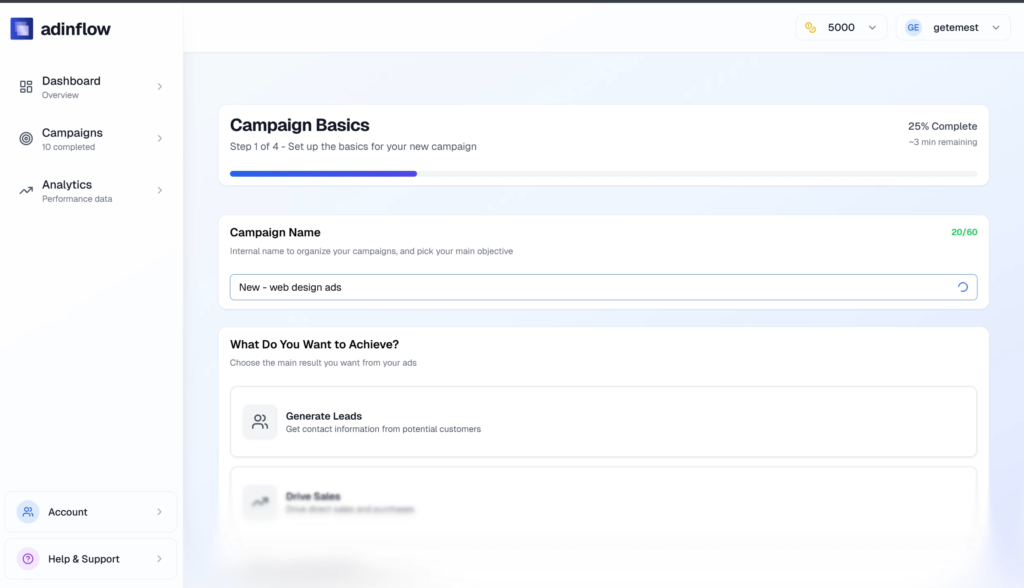
Adinflow is an AI Google Ads platform built by real marketers, specifically for performance use cases like e-commerce.
It automatically generates:
-
Full Google Ads campaign strategy
-
Structured ad groups per product or category
-
Conversion-focused ad copy
-
Smart budget allocation
-
Google Ads policy-safe campaigns
-
One-click export to Google Ads or CSV
-
Analytics and campaign management inside the app
No prompt engineering. No manual cleanup. No second-guessing.
Learn how the workflow works in detail here:
👉 https://blog.adinflow.com/ai-for-google-ads-workflow/
Use Cases: AI Google Ads for E-commerce
Small E-commerce Stores
-
Launch profitable campaigns without hiring an agency
-
Avoid beginner mistakes in Google Ads
-
Compete with bigger brands using smarter structure
Related guide:
👉 https://blog.adinflow.com/google-ads-for-small-business/
Scaling DTC Brands
-
Launch new product campaigns in minutes
-
Maintain consistent ad quality across catalogs
-
Focus internal teams on CRO and merchandising
Agencies Managing Multiple Stores
-
Standardize campaign quality
-
Reduce setup time by 80%+
-
Onboard clients faster without sacrificing performance
AI Google Ads and Google’s 2026 Landscape
Google continues to push automation — but advertisers still need control.
AI Google Ads tools fill the gap between:
-
Manual campaign creation
-
Fully black-box automation
They give you:
-
Structured, explainable campaigns
-
Clear keyword–ad alignment
-
Human-level strategy with machine-level speed
Google itself confirms the importance of relevance and structure in Search Ads performance:
👉 https://support.google.com/google-ads/answer/6146252
Why AI Ads Generator Beats Generic AI Writers
Generic AI writers create text.
AI Google Ads platforms create performance systems.
Key differences:
-
Ads tied to keywords, not prompts
-
Structure optimized for Google Ads, not blogs
-
Built-in compliance checks
-
Real performance logic, not creativity guesses
That’s why e-commerce brands moving serious ad spend are shifting away from manual workflows.
How to Get Started (Without Risk)
You don’t need to migrate everything at once.
A smart approach:
-
Pick one product or category
-
Generate a full campaign with AI
-
Launch alongside existing campaigns
-
Compare CPC, CTR, and conversions
Most teams see performance improvements within the first weeks.
You can start here with a free trial:
👉 www.adinflow.com
No credit card. No setup headaches.
Frequently Asked Questions
Is AI Google Ads safe for e-commerce accounts?
Yes — when the platform is built specifically for Google Ads compliance and real-world use cases.
Does AI replace Google Shopping campaigns?
No. It complements them by improving Search Ads, brand campaigns, and category-level targeting.
Can AI ads generator handle large catalogs?
Yes. That’s one of its strongest advantages over manual setup.
Will Google penalize AI-generated ads?
No. Google cares about relevance and compliance, not how ads are created.
Do I still need a Google Ads expert?
AI reduces manual work, but strategy and optimization still matter — just with far less friction.
Is this better than hiring a Google ad agency?
For many e-commerce brands, AI provides faster execution and lower costs — without long-term contracts.
Final Thoughts
E-commerce Google Ads is no longer about who works harder — it’s about who builds smarter systems.
AI Google Ads lets you launch better campaigns, faster, with fewer mistakes and more consistency.
A modern AI ads generator doesn’t replace marketers — it gives them leverage.
If you want to stop fighting Google Ads and start scaling profitably, this is the direction the industry is already moving.
👉 Start your free trial here:
www.adinflow.com